

I fell because I was going too fast.
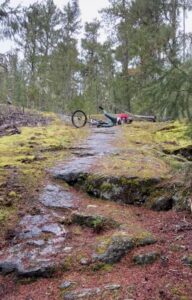
I was mountain biking in Whistler on a wet day. I was nervous riding down a steep, rocky trail, so I did what I tend to do: focus on balancing, keep my speed up, and try not to think too much about being nervous.
I was looking ahead, but I wasn’t really seeing what was in front of me. I wasn’t pausing to read the terrain and choose my line.
One moment I was making it. The next I was on the ground, wiped out by a mossy patch on the rock. Thankfully, I was fine. But it was a rather effective reminder:
When we move too quickly, we don’t always see what is right in front of us, and we may not make the best choices.
It made me think about leadership. The more senior we become, the more power we have to fill the space. We have the experience, the authority and often the answers. People look to us to make the call. Yet perhaps one of the most underused leadership tools is the ability to leave some space open.
A Pause Can Help You Make Big Decisions
My biggest pause came when I stepped away from a high-flying, fast-paced 25+ year corporate career across Sony, Reebok and adidas and returned home to Singapore. For the first time in many years, there was no obvious “next”. What now?
I gave myself space to slow down and ask the deeper questions. What drives me? What matters beyond achievement? How could I continue to contribute from what I had learnt as a business and people leader working across multicultural environments?
That space eventually led me to executive coaching. And joining The Preston Associates gave me a new language for something I was beginning to experience: the value of being a thinking partner.
Sometimes the most useful thing we can offer another person is not an answer. It is space. Space to think more deeply, challenge assumptions and see possibilities.
A Pause Can Help You See Yourself Better
Recently, a leader I coached had an insight about how she celebrated her team’s achievements. She recognised that she usually celebrated when the team reached the target. But what about pausing along the way to recognise the effort, progress and small wins that fuel momentum?
I asked, “Who does that start with?”
She paused. There was a long silence. Her eyes filled with emotion.
Then she said, “I don’t celebrate me.”
That moment didn’t come from another question. It came from the space between the question and her answer. How often do we miss these moments because our minds are already somewhere else? The next meeting. The next email. The next thing to say.
A Pause Can Change the Conversation
I experienced this in a very different context, years earlier as a business leader managing stakeholders. I remember a moment with an MD when I had to find the courage to pause.
His style was direct. He would naturally focus on what hadn’t gone well and what could have been better. We would take the feedback and move on.
This time, I paused before responding. And, in a way, I paused him too.
I acknowledged his feedback, paraphrased what I had heard to make sure I understood, and then asked, “Could you also share what you appreciated about what we did, so we know what to build on?”
Silence. An awkward silence.
For a moment, I wondered, What have I just done? Then his expression softened. He paused too. And something shifted. He began to share what had gone well.
The pause had given him a moment to look at the same work differently: not only through the lens of what was missing, but also through the lens of what was already working. What he shared became one of the greatest compliments I could bring back to my team. More importantly, it gave them confidence and energy to keep improving.
We knew what was good. Now we knew what we could build on to move from good to great.
That year, we were also recognised as the best-performing business unit. Looking back, that pause was more than managing up or handling a difficult stakeholder conversation.
I hadn’t challenged his authority. I hadn’t defended myself. I had simply created enough space for a different perspective to emerge.
And perhaps that is another power of the pause: it can influence without pushing.
Sometimes pausing is not about saying less. It is about creating enough space for more awareness, perspective and possibilities to enter the conversation.
What Happens When You Don’t Fill the Space?
In coaching, the instinct can be to fill silence: ask another question, offer an observation, make sense of what has just been said. But sometimes, the silence is where the thinking begins.
When we give someone enough space, something may emerge that wasn’t immediately available:
“I hadn’t thought about it that way.”
“Actually, I think I’m avoiding something.”
“I realise I’ve been solving the wrong problem.”
This applies directly to leadership.
• When someone in your team is struggling, do you immediately solve the problem, or ask, “Tell me more”, and wait?
• When a talented leader comes to you for advice, do you tell them what you would do, or ask, “What do you think?”
• When everyone looks to you for the answer in a meeting, do you provide it, or leave enough space for someone else to think?
Our answer may solve today’s problem. Their thinking may build tomorrow’s capability. The pause changes more than the conversation.
There is some interesting science behind this. Research on speech has found that a silent pause can change how listeners process what comes next. In one study, words presented after a silent pause were more likely to be recognised later. In other words, the pause can make what follows more memorable.
Breathing matters too. Research suggests that slower breathing can influence our physiological state. Taking a slower breath may help us create a little more room before we respond. Perhaps this is why the pause can feel uncomfortable.
I am reminded of my father. He had a particular kind of silence that needed no explanation. Don’t push your luck. Even now, I know exactly what that silence meant.
Silence can communicate. And a pause isn’t avoidance. It isn’t indecision or doing nothing. It is an intentional space.
Start now. Start small. You don’t need a retreat or a sabbatical. Start with three small pauses:
• Before you respond: Take one breath, especially when something triggers you.
• When someone finishes speaking: Wait two seconds before answering. You may be surprised what comes next.
• Before your next meeting: Take 30 seconds to notice how you are arriving: rushed, distracted, curious or grounded.
Your state enters the room with you. These pauses are tiny. But for a senior leader, they can change the dynamic of the room.
Your position already gives your words weight. You don’t always need to add more. Sometimes, you need to create more space.
Back on the trail
I tackled another challenging rocky trail in Whistler, Top of the World. This time, I paused. Breathed. I felt grounded.
Noticed. I could see the rocks, the terrain and the possible lines ahead.
Chose. I trusted myself and picked my line.
Went.
I cleared it. And celebrated. The irony was that slowing down didn’t stop me from moving forward. It gave me more choice about how I moved. Perhaps leadership is much the same. The pause isn’t about becoming less decisive, less ambitious or slower to act. It is about creating enough space to see more clearly, listen more deeply and choose more deliberately. Especially when the stakes are high. Especially when everyone is looking to you for the answer. And especially when your instinct is to keep going.
Pause.
Breathe.
Notice.
Choose.
Go.
What might become possible if you left just a little more space?
Sources
• MacGregor, Corley & Donaldson (2010), Neuropsychologia. Article
• Zaccaro et al. (2018), Frontiers in Human Neuroscience. Article
Rina Ho, with over 25 years of leadership experience across Asia Pacific, including senior roles at adidas, Reebok and Sony, is an Executive Coach at TPA Asia, helping senior leaders and teams unlock performance through commercially grounded, practical coaching.
Reach out to discover how TPA can help enhance performance across your organization through executive and team coaching
To receive more expert articles from our coaches on a monthly basis you can register to TPA’s Leadership Digest here