
Self-led leadership is the calm, compassionate center of who we are. When Self is leading, we embody qualities that are the hallmarks of great leaders: clarity, curiosity, courage, creativity, and connectedness. Instead of being flooded by reactivity, defensiveness, or fear, we respond with presence and wisdom in times of stress. Authentic leadership grows when leaders cultivate a strong inner foundation of clarity, balance, and compassion within themselves before they lead others.
To understand leading from the inside out, it can be helpful to draw from Internal Family Systems (IFS) leadership, a therapeutic model developed by Dr. Richard Schwartz. At its heart, IFS teaches that each person isn’t one singular internal voice but a system of parts that influence our thoughts, emotions, and behaviors. True leadership—what IFS calls self-led leadership—emerges when we bring these parts into harmony. Authentic leadership develops from the resulting inner calm and confidence which allows the Self to lead with focus and impact.
The Core of Self-Leadership
Think of your inner world divided into the three main ways you respond to the outside world: a protective part, a reactive part, and a vulnerable part. These parts make up an internal family system all doing their best to represent the core of who you are, the Self. The biggest change in self-led leadership is that you decide how to show up in the world treating your inner self with compassion so you can respond wisely rather than react. When a part of you tries to take the lead in an unhelpful or harmful way, the Self provides love and support for that part to calm down and step back to lead in a more balanced way.
For leaders, this concept of Self is a reminder that effective leadership is not about letting our different parts speak for the whole. Instead, it is about creating enough inner space to notice competing impulses, listen to them with compassion, and guide them toward alignment so we can lead from our true and best selves.
Emotional Intelligence (“EI”) in Leadership
At some point during the leadership journey, people will encounter the emotional intelligence in leadership framework, which focuses on self-awareness, self-management, social awareness, and relationship management.
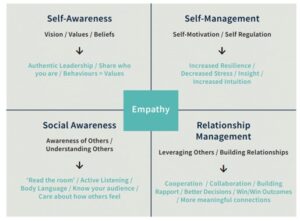
Self-led Leadership compliments emotional intelligence by utilizing each of those approaches:
Emotional Intelligence calls for self-awareness in leadership through the leader acknowledging and understanding what Part is speaking for them at any given moment.
The leader turns to self-management skills by asking the Part to step back and allow the Self to manage going forward.
Once the Self is in control and managing the Parts, it can present in a much more open, balanced way and grow social awareness of other’s concerns.
Lastly, self-led leaders can manage relationships more effectively by showing up grounded, present, and trustworthy. A self-led leader cultivates relationships that are mutually beneficial and based on trust and respect.
Self-Led Leadership in Action
Awareness Before Action
A self-led leader notices their internal state before making decisions. For example, if anger arises in a meeting, instead of reacting impulsively, the leader pauses and asks: “Which part of me feels threatened right now?” This reflective moment opens space for more grounded action and demonstrates leadership presence.
Compassion for Self and Others
By practicing compassion toward their own parts—especially the critical or fearful ones—leaders naturally extend the same compassion to colleagues. They shift from judgment to understanding, fostering a culture of psychological safety at work.
Curiosity Over Certainty
A self-led leader embraces curiosity rather than clinging to rigid certainty. Just as they explore their own internal conflicts with openness, they approach external challenges with flexibility and a willingness to learn. This is similar to embracing a growth mindset for leaders rather than a fixed one.
Integration Instead of Suppression
Rather than silencing difficult emotions or “negative” traits, a self-led leader integrates them. For example, the inner perfectionist can transform from a relentless critic into a guardian of excellence once it is understood and guided by Self. This demonstrates the power of resilient leadership in practice.
How To Practice Self-led Leadership:
Leaders can help their team members practice self-led leadership by guiding them to:
• Identify and acknowledge their internal Parts without judgment.
• Distinguish between when a Part is leading and when the Self is leading.
• Develop a practice of pausing, turning inward, and listening with compassion.
• Build trust that their Self has the wisdom to lead both internally and externally.
The Power of Leading with Self:
When leaders cultivate self-leadership, the impact radiates outward. Teams experience a steadier, more grounded presence. Organizations benefit from leaders who are less reactive, more empathetic, and more authentically connected to their values.
Ultimately, self-led leadership fosters not only stronger results but healthier, more human work cultures. It creates environments where trust and psychological safety thrive, allowing people to contribute their best ideas without fear. Decisions are guided by clarity rather than ego, enabling leaders to balance short-term demands with long-term vision. In this way, authentic leadership becomes a catalyst for resilience, adaptability, and sustainable leadership success across the entire organization.
Brian McKeon, with over 25 years of experience in financial services, including senior roles at Citigroup, Deutsche Bank and RBC, is an Executive Coach at TPA.
To receive more expert articles from our coaches on a monthly basis you can register to TPA’s Leadership Digest here